 Sean Thornton
Sound design & Wwise implementation · Moon Spider Studio · PC (Steam) · 2015
Harold
I worked directly with renowned composer Olivier Deriviere at a budding indie game studio on Miami's Key Biscayne.
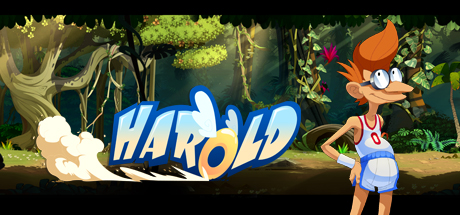
Harold is a hand-animated platformer-racer in which you play a guardian angel and Harold runs on his own. The player controls the environment around him, so the game plays like a platformer with its rules inverted. Moon Spider was a self-funded Florida studio of roughly eight to twelve people, and the art team aimed for the look and motion of classic hand-drawn animation. Audio had to keep up with that, and it also had to carry gameplay information.
A world built from Key Biscayne
I made thousands of sound effects for Harold, almost all of them recorded locally and inspired by the environments of Key Biscayne. I recorded footsteps and impacts in our company parking garage. I also went through the dumpster and found an old stick of bamboo, an empty bleach bottle, and assorted scraps of plastic, all of which became part of the game’s sonic palette. I worked alongside composer Olivier Deriviere, who had a strong aversion to stock sound effects libraries. That pushed me to build everything from scratch.
The snow problem
My favorite challenge was footsteps in snow. Olivier had very exact standards for the sound of hard-packed, creaking snow, and I was working in the subtropics, where there was none. It was probably the most-rejected sound in the project. The version that finally passed came from grinding my knuckles into the cushion of a leather chair.
Real-time systems in Wwise
Audio on Harold was implemented in Wwise, which Deriviere has said was essential to what he wanted on the project. I used RTPCs to make effects respond convincingly to player input. Hot air pipes and water splashes, for example, run continuously and react in real time. Heavy use of random containers kept footsteps and impacts from sounding obviously repeated, which matters in a game where players retry the same sections over and over. I also learned Cubase specifically for this project.
The game also uses audio as a gameplay tool: when the camera jumps ahead to let you reposition obstacles, the music stays on Harold and fades in as he approaches, so you can track where he is.
Timeline and reception
Harold was announced in August 2012 and released on February 12, 2015, after more than four years of development. Reviews were mixed, but the audio was singled out. Gamersyde praised the remarkable soundtrack and sound effects work, and Windows Central called the sound design fantastic.
It remains one of the most challenging and rewarding projects I’ve worked on.
back to portfolio